Troubleshooting
Resetting a Monogram Appliance: What It Fixes and What It Only Hides
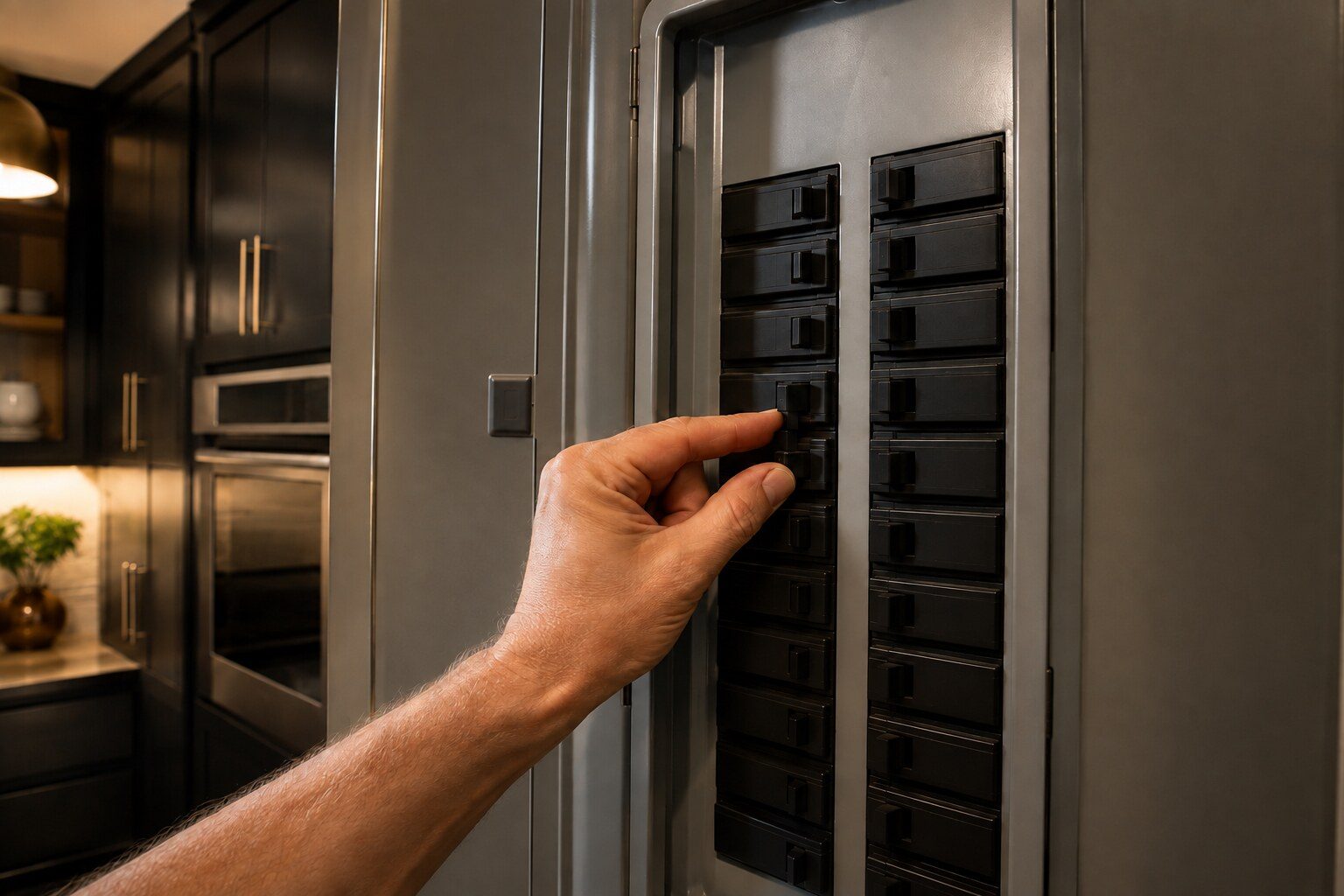
A reset means cutting power at the breaker for a period and restoring it, which empties whatever state the control was holding. The manufacturer's own documents name it as the first step for specific codes — the dishwasher's C3 and C7 ask for about thirty seconds at the breaker, and DE demonstration mode on refrigeration clears by unplugging for a minute or two. For those, a reset is a legitimate test rather than a workaround: if the code goes and stays gone, the condition was transient; if it returns, you have learned something real. There are two places where clearing it is the wrong move. LEAK DETECTED and 999 have canceled a cycle to keep water off the floor, and resetting them empties the message and not the base tray. And photographing any code before you clear it costs nothing, because the characters are most of the diagnosis and they do not come back.
The full guide
A reset is a test, and the result is information
There is a way of thinking about a reset that makes it useful rather than superstitious. Cutting power empties the control's held state — the code it is displaying, the position it thinks a mechanism is in, the count of something that has happened. When power comes back, the control looks at the appliance afresh.
So a reset asks a question: *is this condition still here?*
If the code does not come back, the condition was transient. That happens — a supply blip, a sensor reading taken at the wrong moment, a mechanism that had stopped between positions. If the code does come back, the condition is present, and you have moved from "something odd happened" to "something is wrong", which is genuinely worth knowing before anybody is called.
What a reset never does is repair anything.
Where the manufacturer asks for one
Several of the documented codes name it as the first step, and it is worth doing when they do.
Dishwasher C3 — the machine will not drain. The documents ask for power off at the breaker for about thirty seconds, then a reset of the machine. If it persists after that, it is service.
Dishwasher C7 — the water temperature sensor circuit is inoperative. Same instruction, same thirty seconds.
Dishwasher C4 — the machine filled twice after a power failure, usually a stuck float. The instruction is a start-then-cancel, and tapping the float cover in the front left corner of the tub floor to free it.
Refrigeration DE, in capitals — demonstration mode, where lights and controls run and cooling is off on purpose. Unplugging for a minute or two clears most of these. If it survives that, the manufacturer's own advice is to contact them with the model number, because it is not a repair you can force.
PF anywhere — the power was interrupted. Clearing it is the whole of it.
The two where clearing it is wrong
LEAK DETECTED and 999 on a dishwasher. These are not a display problem. A float in the base tray under the machine has found water, and the control canceled the cycle to keep that water off the floor. A reset clears the message and leaves the tray exactly as full as it was, so the next cycle adds to it. On a machine built into a cabinet run, with a floor under it that costs more than the appliance, that is the one message not to make disappear.
Anything you have not photographed. This is not a rule about codes, it is a rule about evidence. The characters on a display are most of the diagnosis, and after a reset they are gone. Photographing takes two seconds and it is the difference between a technician arriving with a lead and arriving with a description.
What survives a reset and what does not
Clocks and timers go. Temperature set points on refrigeration generally survive, and so does Sabbath mode. On an oven the calibration offset survives — which matters, because if somebody has calibrated your oven, a reset does not undo that work.
Ice makers behave slightly differently: after power returns, production restarts on its own schedule and the first harvest can be some hours away. That is not a failure and it is a common reason people conclude a reset made things worse.
And a refrigerator that has been off for two minutes will not start cooling the instant power returns. Compressors have a built-in delay to protect themselves against short cycling. Silence for a few minutes afterwards is designed behavior.
The honest limit of this page
A reset is the free step between noticing something and calling somebody. It resolves a real share of intermittent complaints and it costs nothing.
What it should never become is the routine. A code that is cleared every Tuesday is a condition that has been present for weeks, and the reset has been hiding it rather than fixing it. If you find yourself resetting an appliance on a schedule, the schedule is the diagnosis.
Where the switch actually is, by appliance
A reset is only simple if you know what to switch off, and on built-in equipment there is rarely a plug to pull.
Refrigeration. The breaker. Built-in cabinets are hard-wired or plugged into an outlet behind cabinetry that nobody can reach, so the panel is the answer. Label the breaker while you are there — every future conversation is easier for it.
Dishwasher. Very often there is an isolating switch in the cabinet under the sink, fitted so a plumber can work safely. It is at exactly the height where a stored bottle knocks it, which is worth knowing for a different reason as well. If there is no switch, the breaker.
Range and wall ovens. The breaker, and on these it is usually a double-pole breaker. Switch it fully off — a breaker tripped to a middle position looks identical to "on" from three feet away, and that single detail is the most common false negative anybody gets in a panel.
Microwave and Advantium. The breaker, or on some installations a switch above the run.
What a reset will not fix
It is worth listing, because a reset that does nothing is often read as an appliance that is beyond help.
It will not clear a mechanical condition. A door that is not latching, a drawer that will not open, a burner cap seated wrong and an iced-up evaporator all survive any amount of power cycling.
It will not clear a condition that is still present. A temperature sensor that has drifted reports the same wrong number the moment the control asks it again, so F3 and F4 come straight back — and that is useful rather than disappointing.
And it will not empty a base tray, which is the whole argument about leak messages.
The pattern that means something
Keep a note of what happens after a reset, because the pattern is the diagnosis.
Never comes back. Transient. Something happened once and has not happened since. Reasonable to let it go.
Comes back within a cycle or a day. Present and persistent. That is a real condition and the reset has confirmed it rather than failed.
Comes back every few weeks. The most informative and the most annoying. An intermittent connection, a marginal sensor, a component that behaves when it is cold and misbehaves when it is hot. In a coastal kitchen the first of those is far more common than people expect, because salt air gets into connectors and a connector with resistance in it is intermittent by nature.
Bring that pattern to a technician and it changes where the meter goes first.
The one that is worth a note in the kitchen
If a household finds itself resetting the same appliance on a rhythm — every Sunday, after every heavy load, whenever the weather is hot — then the reset has become a maintenance routine for a problem nobody has diagnosed.
That is not a failing on anybody's part; it is a very reasonable response to an appliance that works again afterwards. But the rhythm is data, and it is usually the single most useful thing anyone can tell us. Appliances that misbehave to a schedule are misbehaving for a reason, and the schedule is most of the way to it.
If it turns out to be a repair
What this leads to, and what it costs
Every job on this site is priced the same way: an on-site diagnostic first, the figure agreed in writing before anybody starts.
-
Monogram refrigerator error code PF
Monogram refrigerator error code PF: The power to the appliance has been interrupted. Which machines can actually raise it, where the number lives on this make, and what to do next.
What this one means -
Monogram refrigerator DE demo mode code
Monogram refrigerator error code DE: Demonstration mode. Lights and controls behave completely normally and the cooling system is switched off on purpose. Which machines can actually raise it, where the number lives on this make, and what to do next.
What this one means -
Monogram dishwasher error code C3
Monogram dishwasher error code C3: The dishwasher will not drain. Which machines can actually raise it, where the number lives on this make, and what to do next.
What this one means -
Monogram dishwasher LEAK DETECTED error code
Monogram dishwasher error code LEAK DETECTED: A possible leak has been detected and the cycle has been canceled. Which machines can actually raise it, where the number lives on this make, and what to do next.
What this one means

Questions people ask about this
Is there a reset button?
Not on most of these. The reset is the breaker, or the isolating switch under the sink for a dishwasher. Some ice makers have a small reset on the module itself, and some dishwashers respond to a start-then-cancel sequence, but the general answer on this line is that power is the reset.
How long should the power be off?
Thirty seconds is what the manufacturer asks for on a dishwasher. A minute to two minutes for refrigeration, which is also what clears demonstration mode. Longer than that adds nothing except a warming cabinet.
The code came straight back.
Then the reset did its job. A condition that survives a reset is a present condition rather than a stuck display, and that is a genuinely useful result — it moves the question from 'did something glitch' to 'what is it'.
Will a reset lose my settings?
Clocks and timers, yes. Temperature set points and Sabbath mode generally survive on refrigeration. On ovens the calibration offset survives, which matters — if an oven was calibrated by a technician, a reset does not undo it.
Troubleshooting
More guides like this one
-

The Temperature Probe and the Sous-Vide Probe: Two Sockets, Two Jobs
A feature guide that doubles as a repair guide, because FD is the probe circuit and most probe complaints are a lead that has been trapped in a door.
Read more -
Taking an Oven Door Off: When It Is Worth It and When to Stop
The sequence is the easy part. The hinge locks and the stop condition are what decide whether this should be attempted at all.
Read more -

Locked Controls on a Monogram Appliance: Where the Lock Hides on Each One
Four different appliances, one problem, and no repair at the end of it. A wet cloth across a touch panel switches these on more often than people do.
Read more
Tell us the model number and what it is doing.
This article is based on:
- Official manufacturer documentation
- Internal repair procedures
- Technician repair history
- Company quality standards