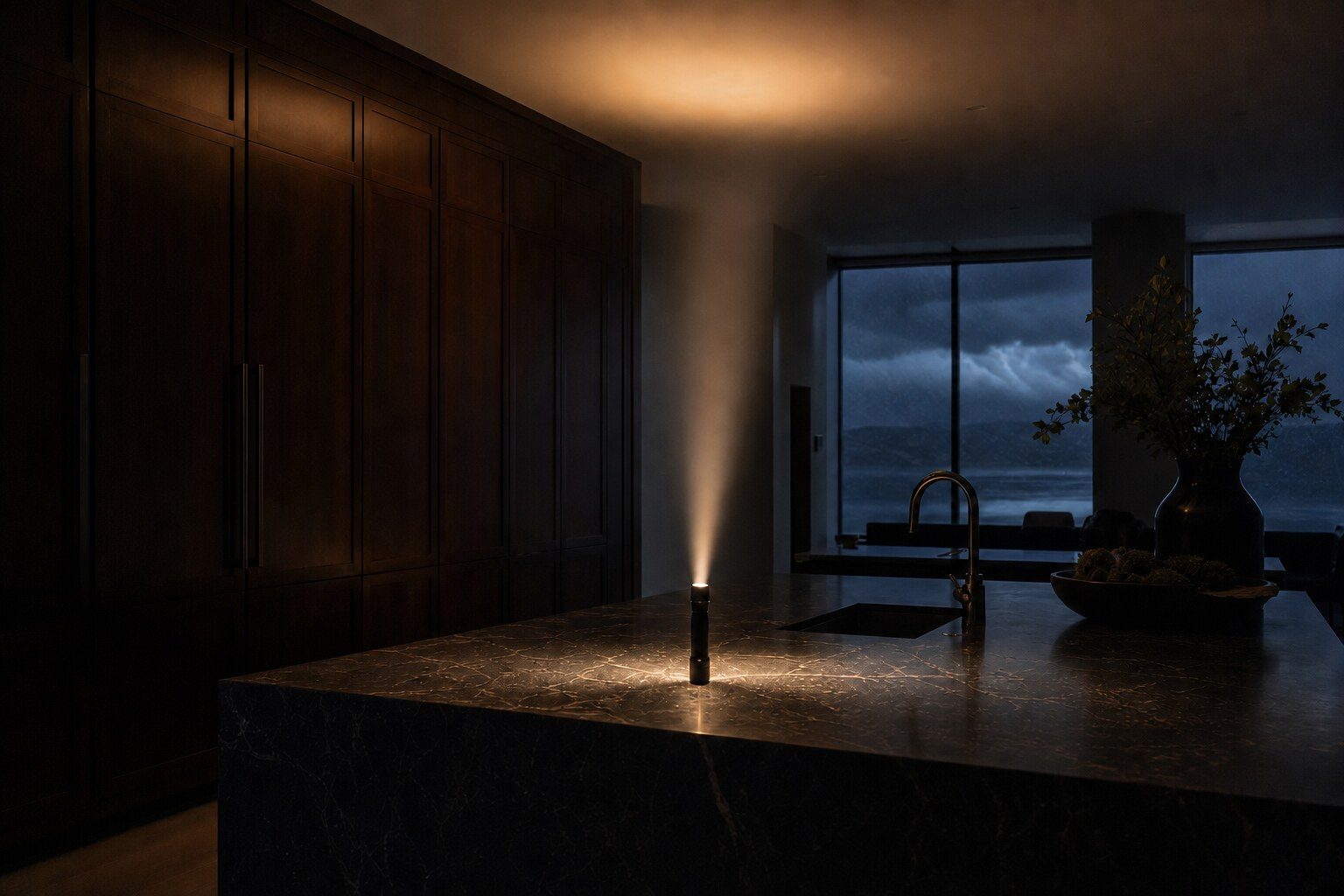
Safety & Risks
After an Outage: How Long the Food in a Built-In Actually Lasts
With the door kept closed, a refrigerator holds food safely for about four hours and a full freezer for about forty-eight, or twenty-four if it is only half full. Those figures assume the door stays shut, and every opening costs a meaningful share of them — which is the single most useful thing to know during an outage. When the power returns, judge by temperature rather than by appearance: food that has been above forty degrees for more than two hours should go, and frozen food that still has ice crystals in it and reads at forty degrees or below can be refrozen. The display may show PF, which simply records that the supply was interrupted, or FF, which on refrigeration means the freezer temperature has risen too high and the frozen food is what to check first. Neither is a repair; both are the appliance telling you what happened while you were out.
The full guide
A South Florida page rather than a general one
This city loses power in a way that much of the country does not, and it loses it in August rather than in February. A kitchen with a pair of integrated columns, a wine cabinet, a beverage center and an ice maker has a great deal of food and a great deal of glass in it, and the decisions after an outage are worth having settled in advance rather than made at nine in the evening with a torch.
The figures
A refrigerator: about four hours with the door closed.
A full freezer: about forty-eight hours. A half-full freezer: about twenty-four.
The gap between those last two is the most useful thing on this page. A freezer full of frozen food is a large block of cold that thaws slowly; a freezer with air in it is not. If your house loses power regularly and your freezer runs half empty, filling the space with bottles of water is free, works, and is worth doing before the season.
The rule that does the deciding
Above forty degrees for more than two hours: it goes.
That is a temperature rule, not a smell rule, and it is worth being blunt about why. The organisms that make people ill in a warm refrigerator do not smell, do not change appearance and do not announce themselves. Food that looks and smells completely normal after six hours at fifty degrees is not safe, and food that has thawed and been refrozen looks worse than it is.
So the useful instrument is a thermometer, and the useful habit is having one in the cabinet already. Every page on this site asks for one; this is the page where it earns its keep in one evening.
Frozen food is judged differently: if it still has ice crystals and reads at forty or below, it can be refrozen. The texture will suffer and the safety will not.
Every opening costs
The four-hour and forty-eight-hour figures assume the door stays shut. They are not a budget you can spend a little at a time.
A refrigerator door opened for thirty seconds in a warm kitchen exchanges a surprising amount of its air, and in a house where the air conditioning has also stopped, the room is not the room you think it is. During an outage the discipline is: decide what you want, open once, take it, shut it.
If the outage looks long, bagged ice in the refrigerator and bagged or dry ice in the freezer buys real hours, and the time to get it is early rather than when everybody else has the same idea.
What the appliance says when it comes back
PF. The power was interrupted. It is a record rather than a problem, and clearing it is the whole of it. After a summer storm this is the most common thing on any display in this city.
FF on refrigeration. The freezer temperature is rising too high, and the manufacturer's own first instruction with this code is to check the frozen food for thawing. It is the one refrigeration code that is about the contents rather than about a component, and after an outage it is the appliance telling you exactly what you already suspect.
If FF is still showing hours after power has returned and the cabinet has had time to pull back down, that is no longer about the outage and it is worth a call.
Two things about built-in cabinets specifically
They do not come back instantly. A compressor has a built-in delay to protect itself from short cycling, so a refrigerator that is silent for several minutes after power returns is behaving correctly rather than failing.
A cabinet that has worked hard to recover will show it. Running continuously for a day afterwards is normal. Running continuously for a week afterwards is not, and it usually means the outage found something that was already marginal — most often a condenser that could no longer shed heat, which is the cheapest thing on this site to correct and the one nothing ever reports.
That is the honest reason this page sits alongside the maintenance ones. An outage does not usually break an appliance. It does find the ones that were about to be found anyway.
Before the season, not during the storm
Three things done in advance make an outage a nuisance rather than a loss, and all of them are free or nearly so.
Fill the freezer. Air thaws fast and frozen mass does not. Bottles of water in the empty space double the time a half-full freezer holds, they cost nothing, and they are useful in their own right afterwards.
Put a thermometer in each cabinet now. Every decision on this page is a temperature decision, and the households that lose the least are the ones who can read a number rather than guess. A cheap dial thermometer in each compartment is the best five dollars in this article.
Know which breaker is which. Labeled, before you need it in the dark. It matters for restoring appliances in a sensible order and it matters far more for the far worse scenario, which is water where it should not be.
The order to restore things in
When power comes back, everything in the house tries to start at once, and refrigeration is the part that has been waiting hardest.
Compressors have a built-in delay to protect themselves from short cycling, so a cabinet that is silent for several minutes is behaving correctly. Leave doors shut for the first hour and let each cabinet pull down before anybody starts reorganizing shelves — every opening in that hour costs more than it does normally, because the cabinet has nothing in reserve.
Ice makers restart on their own schedule and the first harvest can be some hours away. Throw away whatever was in the bin: it has partly melted and refrozen, and it will have taken the smell of the freezer with it.
What an outage finds
An outage does not usually break an appliance. It finds the ones that were already marginal.
A cabinet whose condenser could no longer shed heat coped fine when it was topped up every few minutes and cannot recover from a deep warm-up. A door seal that was letting a little air in all along is a much bigger problem when the cabinet is trying to pull down twenty degrees. A compressor that was working harder than it should have been for two years is asked, in one afternoon, to do the hardest work of its life.
So if a cabinet comes back and runs continuously for a week, that is not the outage's doing in any useful sense — it is the outage having found something. The cheapest possible outcome is a condenser that needs cleaning, and in this city that is also the most likely one.
The generator question
Plenty of houses here have one, and the useful thing to know is what it is worth pointing at.
Refrigeration first, always, and by a distance. It is the only thing in the kitchen where a few hours changes an outcome rather than a convenience. A wine cabinet full of bottles is the second, particularly in August, because heat does more to wine than a short outage does to a freezer.
Cooking appliances are not worth a generator circuit. An induction top will not run on most domestic generators anyway, and a gas range will light with a match when its igniters have no power — which is worth knowing before you need dinner.
If it turns out to be a repair
What this leads to, and what it costs
Every job on this site is priced the same way: an on-site diagnostic first, the figure agreed in writing before anybody starts.
-
Monogram refrigerator error code FF
Monogram refrigerator error code FF: Check the frozen food for thawing, because the temperature is rising too high. Which machines can actually raise it, where the number lives on this make, and what to do next.
What this one means -
Monogram refrigerator error code PF
Monogram refrigerator error code PF: The power to the appliance has been interrupted. Which machines can actually raise it, where the number lives on this make, and what to do next.
What this one means -
Refrigerator not cooling
The call we take more often than any other. On built-in refrigeration the first suspect is almost never the compressor — it is the condenser behind the grille above the door, which in a Miami kitchen collects salt, cooking aerosol and dust until it can no longer shed heat, with nothing on the display to say so.
- The condenser is the first suspect and it is free to check
- A dropped door panel produces this too
- The sealed system is last, not first
-
Freezers
A Monogram freezer is a column: one cabinet, one temperature, flush with the cabinetry and usually standing beside a refrigerator column that looks identical from the front. That pairing is where most calls start, because when one of the two stops behaving the other is still perfect, and the two cabinets have separate machinery, separate sensors and separate problems.
- All-freezer columns in 18, 24, 30 and 36 inches
- Paired columns are two machines, not one
- Ice build-up is a defrost question before it is a door question

Questions people ask about this
Does a built-in cabinet hold longer than a freestanding one?
Usually a little, and not enough to change your decisions. These cabinets are well insulated and they sit inside cabinetry, which helps. What helps far more is a full freezer and a door that stays shut.
Can I refreeze what thawed?
If it still has ice crystals in it and it reads at forty degrees or below, yes — the quality suffers and the safety does not. If it has thawed completely and been above forty for more than two hours, it goes, and that is not a judgement call to make by smell.
The display shows FF now that power is back.
FF on refrigeration means the freezer temperature is rising too high, and the manufacturer's own first instruction with it is to check the frozen food for thawing. After an outage that is the appliance describing what happened. If it persists once the cabinet has had time to pull back down, that is a different conversation.
Should I put ice in the cabinet?
Bagged ice or dry ice in the freezer buys real time if the outage looks long, and it is worth the trip early rather than late. What is not worth it is opening the doors repeatedly to check — every opening costs more than most people expect.
Safety & Risks
More guides like this one
-
An Oven That Smells of Burning: Which Smells Are Normal and Which Are Not
Four different smells with four different meanings, and one of them is a reason to switch the appliance off at the breaker before reading any further.
Read more -
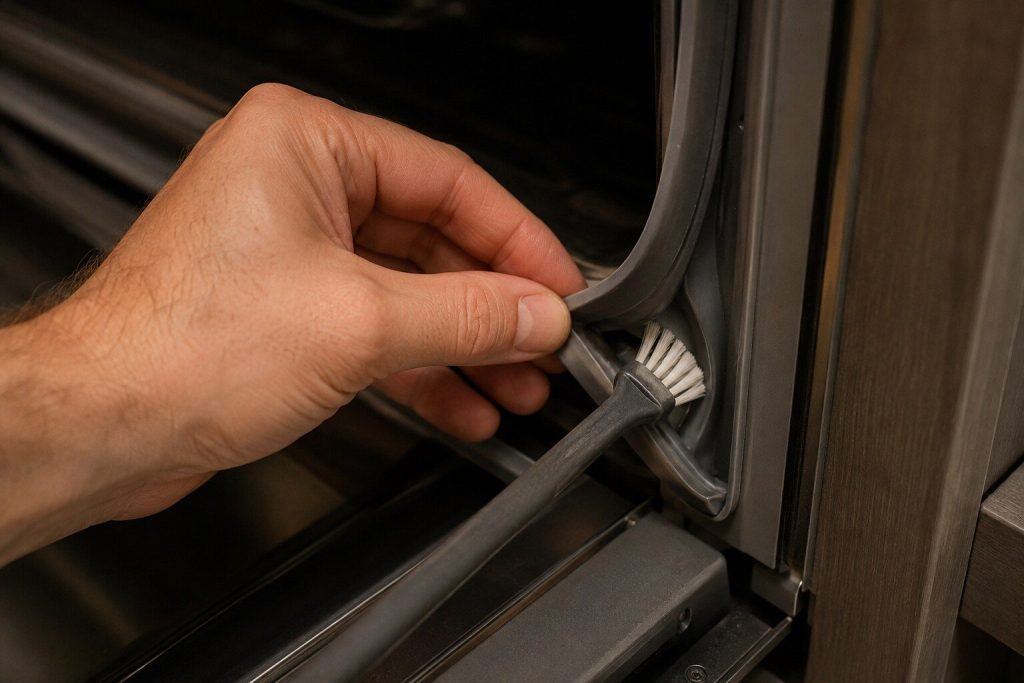
Mold in the Folds of a Door Seal: Getting It Out Without Wrecking the Gasket
The products people reach for are what hardens the rubber. Warm soapy water, a soft brush and the folds opened out does more, and does no damage.
Read more
Tell us the model number and what it is doing.
This article is based on:
- Official manufacturer documentation
- Internal repair procedures
- Technician repair history
- Company quality standards