Maintenance & Prevention
Changing the Water Filter, and Everything That Happens Afterwards
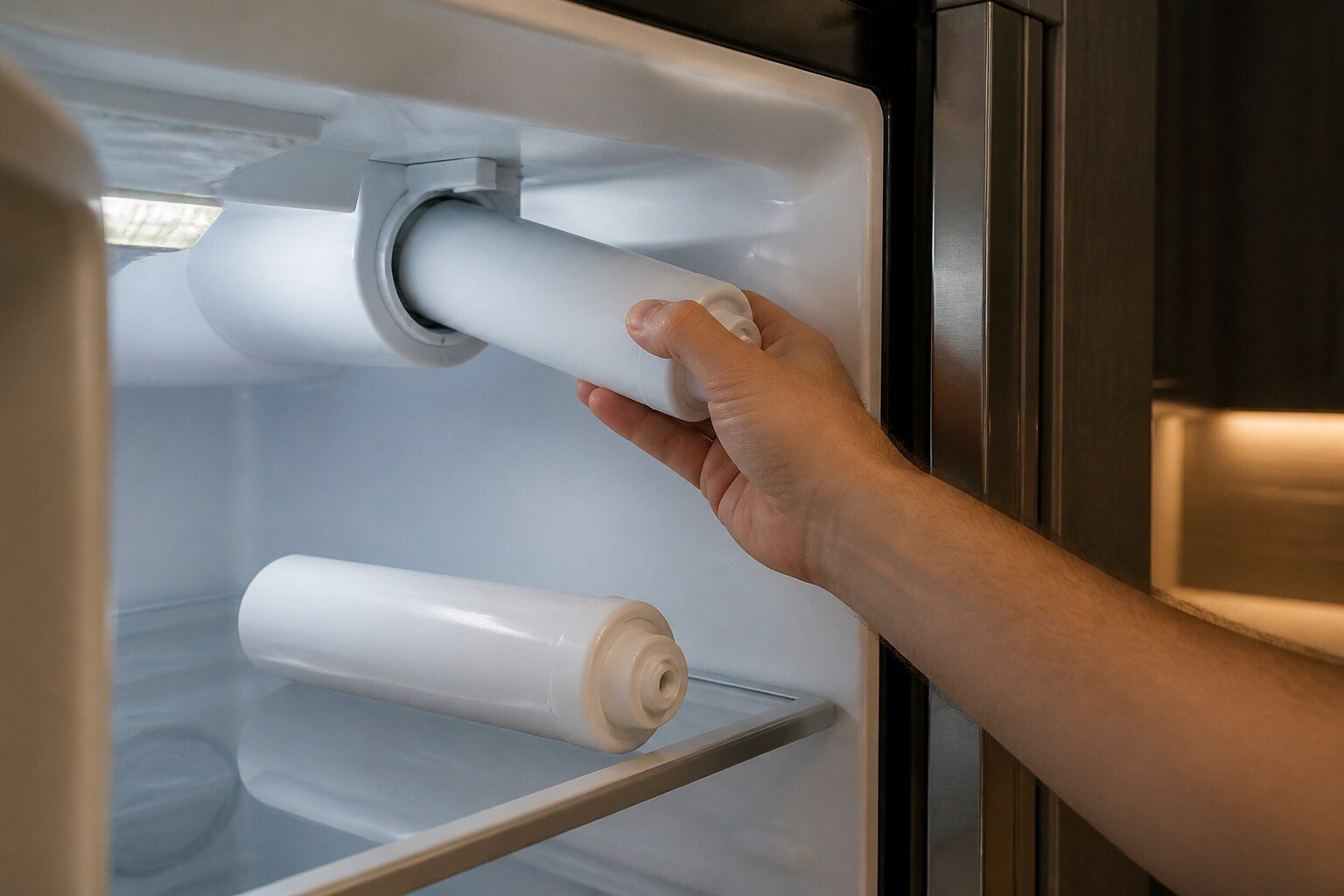
Find the cartridge — on most of these it is inside the fresh-food compartment at the top right or in the upper grille — turn it a quarter turn and pull it out, then push the new one in and turn it back until it seats. That part takes a minute. The part that matters is what comes next: run several gallons through the dispenser before you drink any of it, in short bursts rather than one long pull, because a new cartridge holds air and carbon fines and both come out in the first few glasses. Expect noise while that air clears, expect the first glasses to look cloudy, and expect the ice from the next few harvests to be worth throwing away. Then reset the filter indicator on the panel, which is a separate action from changing the filter and is the step most people skip.
The full guide
A one-minute job with a twenty-minute tail
Changing the cartridge is genuinely simple: a quarter turn, out, in, a quarter turn back. Nobody needs a page for that part.
The page exists because of what happens afterwards, which is where the phone calls come from. A new filter makes the water worse for a few minutes before it makes it better, and a household that does not know that concludes the filter is faulty, the appliance has a problem, or the water supply has changed.
What the first few glasses are
Air. The cartridge and the housing were full of it, and it comes out in the water as a cloud of fine bubbles. Let a glass stand for a minute: if it clears from the bottom upward, that is air and there is nothing wrong.
Carbon fines. New carbon sheds a little dust in its first use. It is harmless and it is why the instruction is to flush rather than to drink.
Noise. The dispenser will spit, gurgle and stutter while the line clears. This is the single most common thing people ring about after a filter change, and it stops on its own.
Flush two or three gallons in short bursts rather than one long pull — bursts move air out far more effectively than a steady stream does.
And throw away the next two or three batches of ice. The ice maker is on the same line and it carries the same air and fines, and there is no point cleaning the water and keeping the ice.
The step almost everybody skips
Resetting the filter indicator. It is a separate action from changing the filter, usually a press and hold on the panel, and the appliance has no way of knowing you have changed anything until you do it.
The reason it matters is not the light. It is that an indicator which is permanently on becomes an indicator nobody reads, and six months later there is no way to tell whether the filter is due or whether the light has just been like that.
Why the printed interval is too long here
Six months is the usual figure. It assumes water gentler than what comes out of a South Florida tap.
Hard water loads a cartridge faster, and the appliance's way of telling you is not a light — it is flow. A dispenser that has slowed noticeably, an ice maker whose production has tapered, or a cartridge that has started to affect taste is a cartridge that is finished, whatever the date says. If any of those have happened, change it now and start the interval from today.
The reverse is worth knowing too: a house with a water softener will get closer to the printed figure, and a second home occupied four months a year will get much longer in calendar terms and about the same in use.
On generic cartridges
They usually fit. The reason to think about it is not performance, it is the seal.
The housing was designed around a particular cartridge's O-rings and a particular flow rate. A cartridge that seals imperfectly does not fail dramatically — it weeps, slowly, inside a cabinet, onto a floor you cannot see. We are called to the results of that more often than to any genuine filter failure, and the repair is never the filter.
If you use a third-party cartridge, seat it firmly and check underneath and behind the appliance a day later.
When it is not the filter
If a new, properly seated cartridge does not restore the flow, the questions after it are the house supply pressure, the inlet valve on the appliance, and — on models with a dispenser in the door — a supply tube that has frozen. That last one is a temperature problem wearing a plumbing costume, and it is worth knowing exists before anybody replaces a valve for it.
Where the cartridge actually is, by cabinet
It is not in the same place across the line, and hunting for it with a torch is a common start to this job.
Built-in side-by-side cabinets. Usually inside the fresh-food compartment at the top, on the right, behind a small hinged cover. Twist-and-pull.
Integrated columns and bottom-freezer cabinets. Often in the upper grille area or behind a panel at the top of the compartment, reachable from the front like everything else on these appliances.
Counter-depth free-standing models. Sometimes in the base grille, which is the only place on this list where the cartridge is at floor level.
If you cannot find it, the manual for your exact model names the location, and it is worth photographing the page along with the plate. Two minutes now saves an argument in eighteen months.
What a filter does not do
Worth being straight, because people ask.
These cartridges are carbon-based and they are aimed at taste, odor, chlorine and particulates, plus whatever specific reductions the manufacturer certifies for that model. They are not a water softener. They do not remove the hardness that scales an ice machine or films glassware in a dishwasher, and a household that expects a refrigerator filter to fix hard-water problems elsewhere in the kitchen will be disappointed.
If scale is the actual complaint — cloudy small ice cubes, filmed glasses, a kettle that furs in weeks — the conversation is about the house supply rather than about a cartridge.
The bypass, and when it is the right answer
Every one of these housings takes a bypass plug: a solid cartridge-shaped part that lets water through without filtering it.
Two reasons to know that exists. It is the fastest possible diagnostic — if flow returns with a bypass fitted, the cartridge was the restriction and nothing else needs investigating. And if a house is empty for months, leaving a bypass in rather than an aging cartridge means nothing is sitting wet and unused in a warm kitchen.
If you have lost the bypass plug, a new cartridge does the same diagnostic job.
What to do after a long absence
A cartridge that has sat unused for months is not the same as a new one. Water has been standing in it, in a warm house, and the first thing to do on returning is to flush several gallons through and throw away the first two or three batches of ice — the same routine as a filter change.
For a house that is closed up for a season, changing the cartridge on arrival rather than on departure is the better habit. The old one has done its work; a fresh one starts its life with the house occupied and water moving through it.
If it turns out to be a repair
What this leads to, and what it costs
Every job on this site is priced the same way: an on-site diagnostic first, the figure agreed in writing before anybody starts.
-
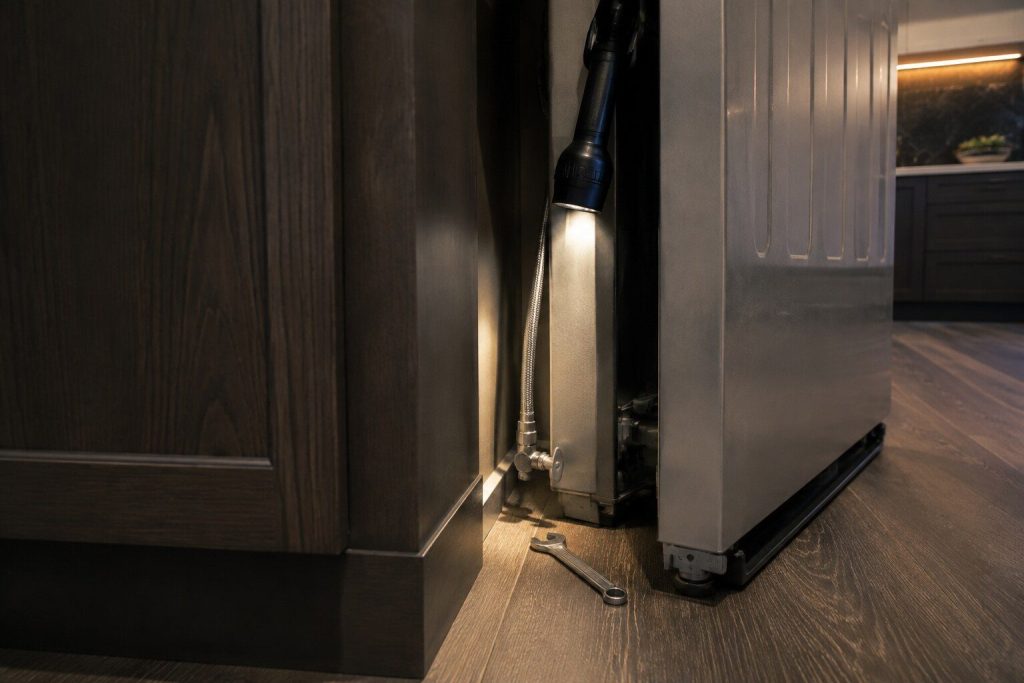
from $125 Water dispenser and filter service
Slow water, no water, or water that tastes of the filter it is supposed to be cleaned by. On local water the filter is the first suspect and very often the only one, and the interval printed on the cartridge assumes gentler supply than South Florida provides.
- Filter, valve and line checked in that order
- Local water shortens every published interval
- Cheap to rule out before booking anything larger
-
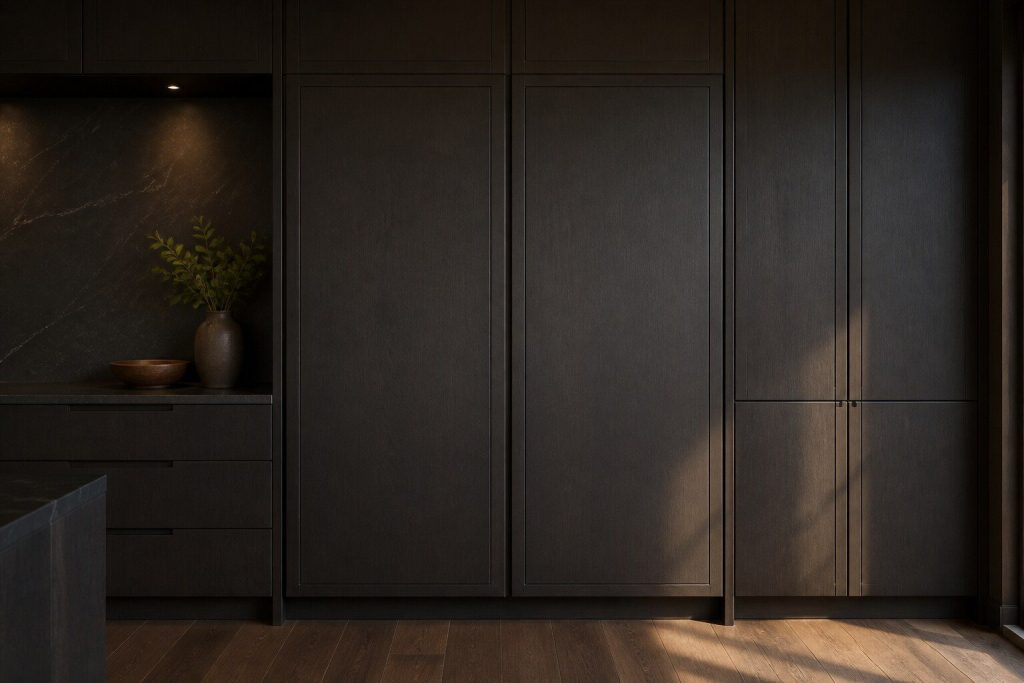
Built-in side-by-side · integrated column · French door · bottom freezer Refrigerators
Monogram refrigeration is built in, and on this make that is not a styling word — it is what the repair has to work around. A 48-inch side-by-side is bolted into cabinetry, a column is flush with the run and carries a custom door panel, and the machinery is reached from the front because there is no behind. The failures are ordinary refrigeration failures. Getting to them, and putting the kitchen back the way the cabinetmaker left it, is the part that takes the skill.
- Built-in and panel-ready models are serviced from the front
- Door panels and alignment are part of the job, not an extra
- Sealed-system work is measured, never guessed at
-
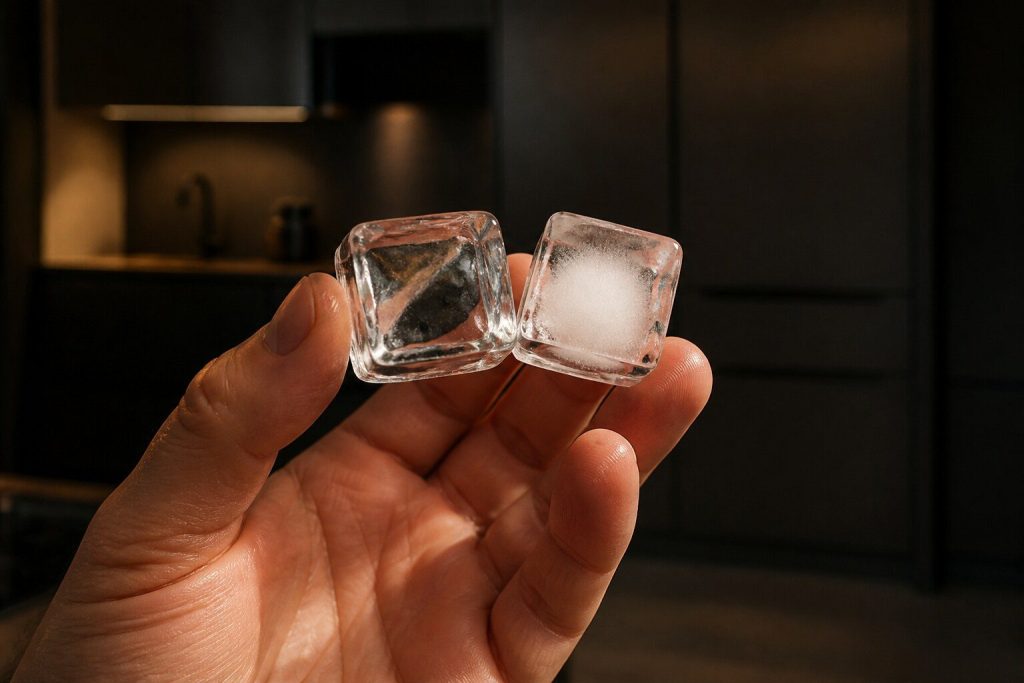
It works, but not properly Ice that is small cloudy or slow
Production that has tapered rather than stopped, with cubes that have got smaller and cloudier. On a standalone machine that is the signature of scale in the water circuit, and on local water it is not a matter of if but of when.
- Small and cloudy is scale, almost always
- Clear ice depends on moving water
- Descaling restores output without parts

Questions people ask about this
How often, really?
Sooner than the date printed on it. Six months is the usual figure and it assumes gentler water than ours. On unsoftened South Florida supply a cartridge is frequently finished before then, and the appliance tells you by slowing down rather than by any indicator.
The water is cloudy after the change.
Air, and it clears. A new cartridge is full of it and the first several glasses carry it out as fine bubbles. If it is still cloudy after a couple of gallons, let a glass stand for a minute — if it clears from the bottom up, that is air and it is fine.
Can I use a generic cartridge?
Physically, often. The reason to be careful is that the seals and the flow rate are what the appliance was designed around, and a cartridge that seals imperfectly puts water where it should not be — inside a cabinet, slowly. We see the results of that more often than we would like.
The dispenser is slower after the change than before.
Check the cartridge is fully seated — a quarter turn until it stops, not until it feels snug. A partly seated filter restricts flow and can leak. If it is seated and still slow, the supply pressure or the inlet valve is the next question.
Maintenance & Prevention
More guides like this one
-

A Year in a Monogram Kitchen: What to Do and When
The calendar the service pages imply and never state in one place, written for built-in equipment in a coastal city.
Read more -
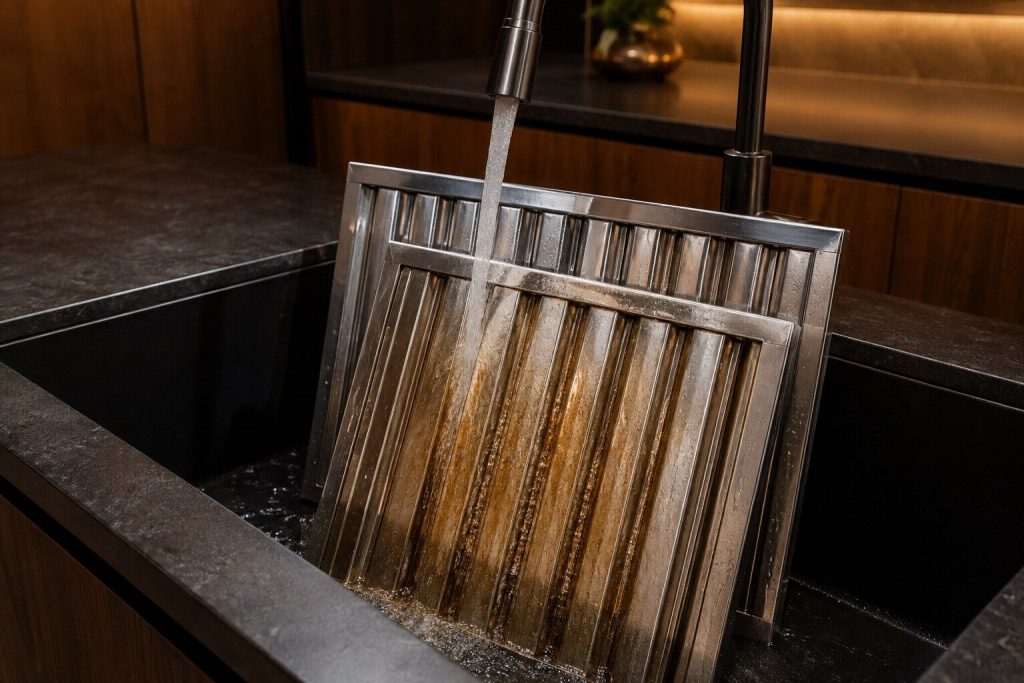
Hood Filters in a Miami Kitchen: Far More Often Than the Manual Says
Grease plus humidity stays tacky, collects dust, and migrates past a saturated filter into the blower housing. That is when it stops being a chore.
Read more -
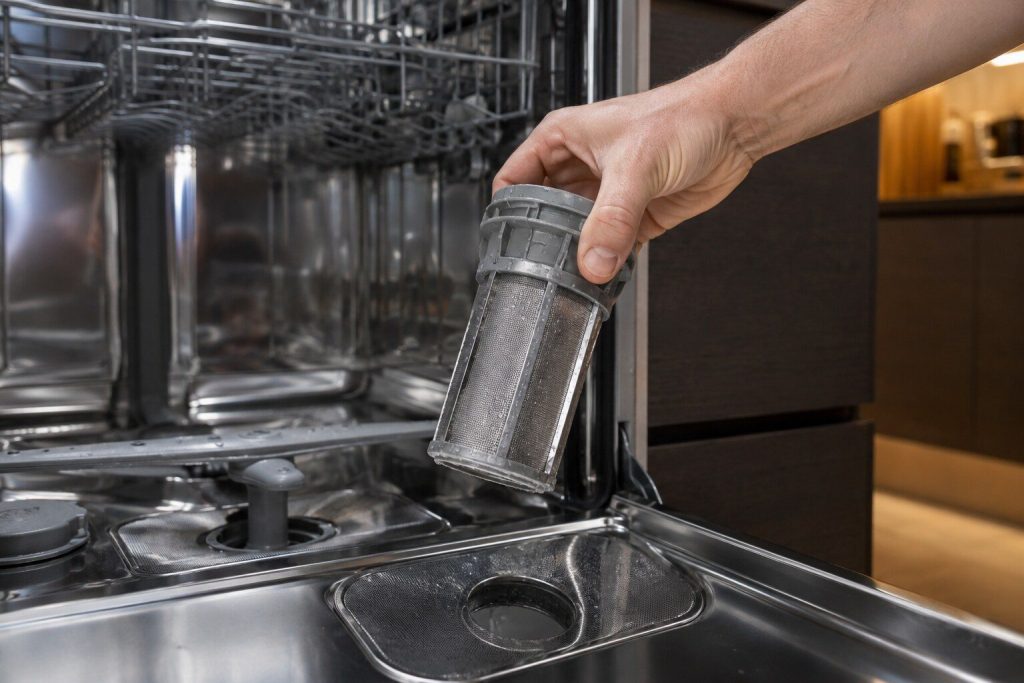
The Filter in the Floor of the Tub: Two Minutes, No Tools
The highest-value thing an owner can do for this appliance, and most have never done it. Quarter turn, lift, rinse.
Read more
Tell us the model number and what it is doing.
This article is based on:
- Official manufacturer documentation
- Internal repair procedures
- Technician repair history
- Company quality standards