
Maintenance & Prevention
A Year in a Monogram Kitchen: What to Do and When
Four intervals cover almost all of it. Monthly: hood filters, and a look at whether the ice bin is draining. Twice a year: descale any dedicated ice machine, and change water filters on unsoftened supply. Annually: clean the condensers on every cold appliance, test every door seal with a strip of paper, and check panel alignment across the run. And once, whenever it is convenient: find out where each appliance's rating plate is and photograph it, because that is the information every future call starts with. Two of those matter more here than anywhere else. A built-in condenser breathes through a grille into the kitchen and collects salt as well as grease, and a custom door panel settles over years until the seal stops meeting the cabinet — and both of those are invisible until they arrive as a refrigeration complaint.
The full guide
Four intervals, and two of them are local
Every service page on this site implies a maintenance habit and none of them states the whole calendar, so here it is in one place. It is short, and two items on it matter far more in this city than they would in a manual written for a general market.
Monthly
Hood filters. Over a professional range with a grill or a griddle, every few weeks. Grease and humidity together stay tacky, and a saturated filter passes what it should be catching into the blower housing and the duct, where cleaning it is a job rather than a chore. Most steel filters go through a dishwasher on their own.
A glance at the ice bin. If there is a dedicated undercounter machine, look at whether meltwater is going down. Some water in the bin is normal; a level that stays is a blocked drain, and standing water in a warm cabinet becomes a smell and then a hygiene job on top of a repair.
Twice a year
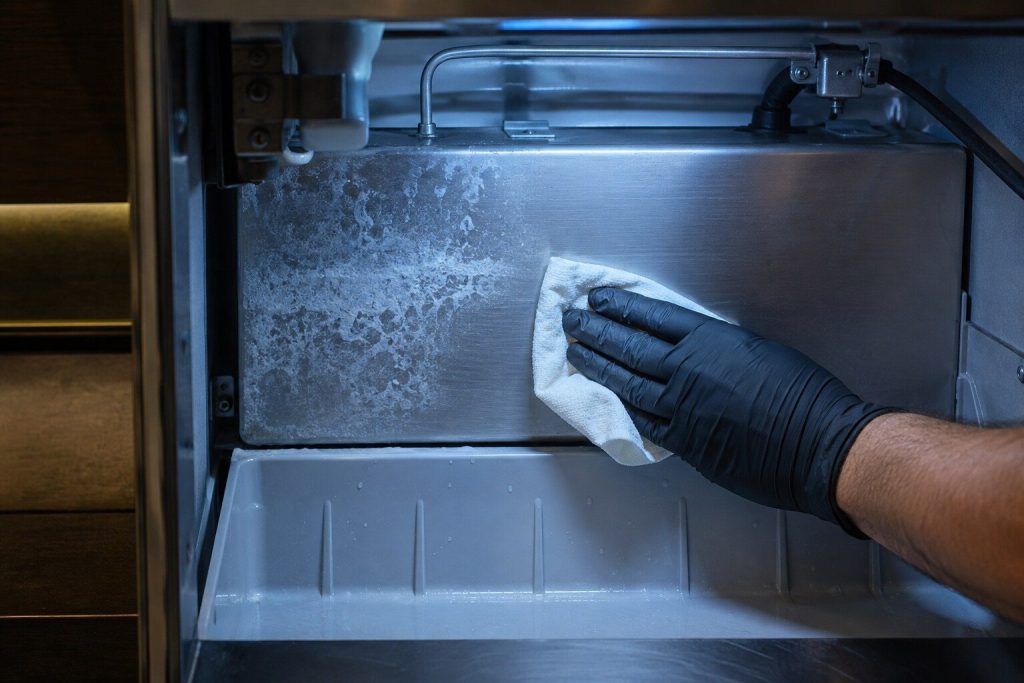
Descale the ice machine. Every gallon of local water that goes through a freezing cycle leaves its mineral on the evaporator plate, in the valve and along the tubing. Production tapers, cubes get smaller and cloudier, and a plate that is descaled on schedule keeps making what it was specified to make. One that is not never quite recovers.
Water filters, on unsoftened supply. The six months printed on a cartridge assumes gentler water than ours. The appliance tells you by slowing down rather than by a light.
Annually
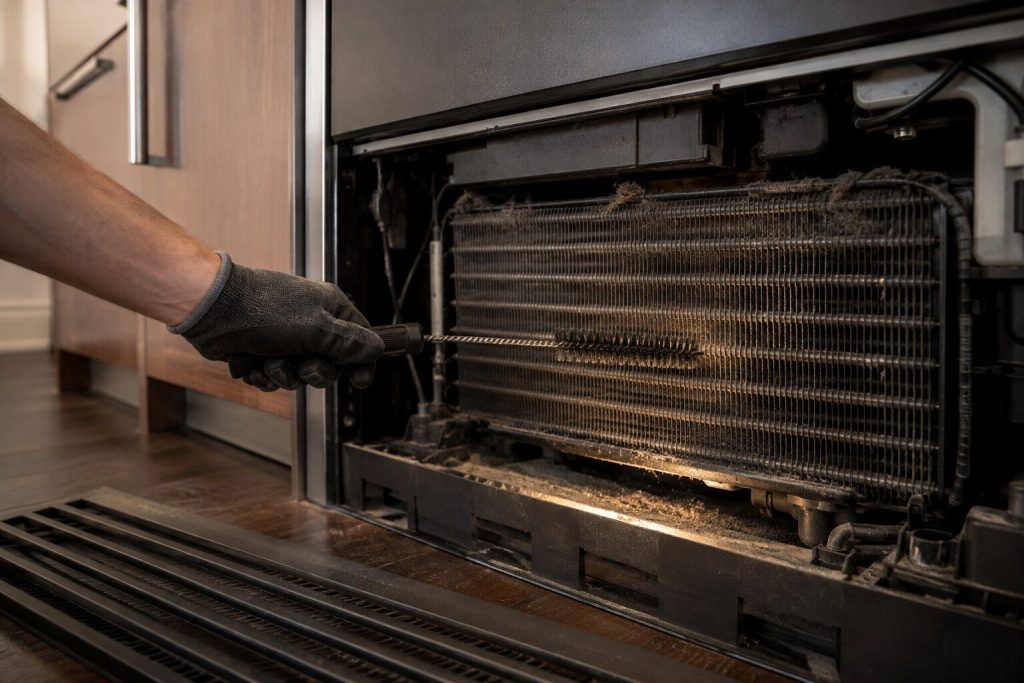
Condensers, on every cold appliance. This is the most valuable hour anybody spends on a Monogram kitchen and it is worth explaining why. A built-in refrigerator does not vent out of the back of a room — it breathes through a grille above its own door, into the kitchen it stands in. That coil collects cooking aerosol, dust and, within a few miles of the water, salt. Nothing reports it. The appliance simply runs hotter and longer, year after year, until the compressor that has been working against it gives up.
Twice a year for houses on the barrier islands or with heavy cooking. Once for everybody else.
Every door seal, with a strip of paper. Close a strip in the door and pull; where it comes out freely, the seal is not meeting the cabinet there. Do it all the way round on every cold appliance and on the ovens. It takes ten minutes for a whole kitchen.
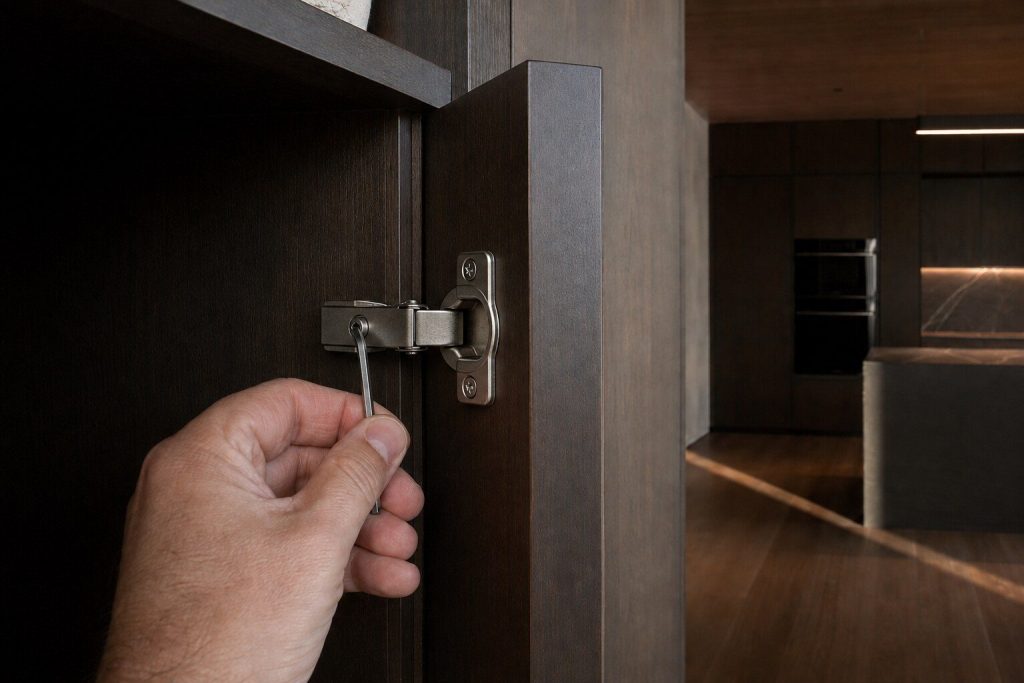
Panel alignment across the run. A custom panel is heavy and the hinges were shimmed for its weight on the day the kitchen was fitted. Doors settle. What you see is a line that no longer matches its neighbor; what the appliance gets is humid air, permanently, and a defrost circuit doing work it was never sized for. Integrated cabinetry drifts together, so it is cheaper to correct the run than to correct one door a year for three years.
Once, and then never again
Find every rating plate and photograph it. Refrigeration: inside the fresh-food compartment, usually the left wall. Dishwasher: on the tub edge behind the door. Ranges and wall ovens: on the frame behind the door, and on some ranges behind the bottom drawer.
Put the photographs somewhere you will find them. Every future conversation with anybody about any of these appliances starts with that number, and hunting for it with a torch while a technician waits is a bad use of everybody's afternoon.
What this does not prevent
It is worth being straight about the limits. Cleaning a condenser extends compressor life and does not guarantee it. A sound door seal keeps a defrost circuit inside its design and will not stop a defrost heater failing. Nothing on this list prevents a control board going, and boards do go.
What the calendar buys is the difference between the failures that are wear and the failures that are neglect — and in a coastal kitchen full of built-in equipment, the second category is much larger than most owners expect.
And for a house that is empty half the year
Do the work before the season rather than after it. A closed-up house through a South Florida summer is a harder environment than an occupied one: the air conditioning is set high or off, the refrigeration is working against a warmer room, and nobody is there to notice a cabinet drifting. Clean condensers and sound seals going into those months are worth more than any inspection afterwards.
Habits rather than intervals
Some of what keeps this equipment alive is not on a calendar at all — it is what happens every day.
Lift pans, do not slide them. On an induction or ceramic top the glass is the most expensive single part of the appliance, and a dragged cast-iron pan is how it gets scored.
Sugar off hot, everything else off cold. The only cleaning rule on this site that runs in the opposite direction to instinct, and the one that prevents permanent marks on cooktop glass.
Leave the dishwasher door on the latch after a cycle. It dries the tub and the seal, and it does more for that gasket than any product.
Wipe cooking surfaces first and control panels last, with a damp cloth rather than a wet one. A wet cloth across a touch panel is a series of presses to the appliance, and it is how tops get locked and timers get set that nobody asked for.
Do not stack against grilles. The bottom of an undercounter door and the top of a built-in refrigerator are ventilation, and treating either as storage is the commonest self-inflicted refrigeration problem there is.
What is worth calling about early
Three things, because all three are cheap now and expensive later.
A cabinet that has started running noticeably more. Long before it is warm. That is usually a condenser or a door, and both are inexpensive at that stage.
A new noise. Fans and mountings are modest parts; what they take with them when they are left is not.
Any water where water should not be. In these kitchens the joinery and the floor are the expensive part of the room, and a slow leak under an integrated dishwasher is invisible until the cabinet base has taken it.
What is worth not calling about
Equally useful, and rarer to see written down.
Refrigeration noise that is gurgling, ticking or a single loud crack during a defrost cycle. Condensation on the inside of a wine cabinet's glass door in August. Wet plastics at the end of a dishwasher cycle, which is condensation drying working as designed. A code that turns out to be tC, tF, LOC, OFF or PF. And an ice maker producing less in August than in February.
All of those are appliances behaving correctly, and every one of them gets reported as a problem somewhere.
Keep a page of numbers
The single most useful thing an owner can do, and it takes twenty minutes once.
Photograph every rating plate. Write down the palette of information every future call needs: model numbers, the date the kitchen was fitted, who fitted it, which breaker serves what, where the water supply valves are, and the date of the last service on each appliance.
Put it somewhere that is not a drawer in the kitchen. Every conversation with anybody about any of these appliances — us, an insurer, the next owner of the house — starts with that page, and assembling it under pressure is how afternoons get wasted.
If it turns out to be a repair
What this leads to, and what it costs
Every job on this site is priced the same way: an on-site diagnostic first, the figure agreed in writing before anybody starts.
-

from $145 Appliance maintenance
The visit that exists to stop the other visits. On built-in appliances in a salt-air climate the two things that shorten life are both invisible: a condenser that has silted up behind its grille, and door seals that have quietly stopped sealing. Neither shows on a display. Both are cheap to deal with and expensive to ignore.
- Condensers cleaned and airflow checked
- Seals, hinges and panel alignment across the kitchen
- Filters, drains and water circuits attended to
-
from $135 Condenser cleaning service
The cheapest service on this list and the one that prevents the most expensive one. A built-in condenser sits behind a grille in the kitchen, and in South Florida it collects salt, cooking aerosol and dust at a rate that surprises people. The appliance never complains. It just runs longer, hotter and shorter-lived.
- Coil, fan and air path on every cold appliance
- Nothing on the display ever reports this
- Directly extends compressor life
-
from $145 Panel alignment and door adjustment
The job that only exists on built-in kitchens, and the one owners most often wait too long to book. A custom door panel is heavy, the hinges were shimmed for it on installation day, and over years the door settles. What starts as a line of light along a cabinet becomes humid Florida air walking into a refrigerator all day, and then a defrost circuit that never catches up.
- Hinges, springs and shims set back to specification
- The seal checked along its whole length, not by eye
- Panel lines put back level with the run
-
from $175 Ice machine cleaning and descaling
The service a standalone ice machine needs on schedule and almost never gets. Every gallon of hard South Florida water that goes through a freezing cycle leaves its mineral behind — on the evaporator plate, in the valve, along the tubing. Production tapers, cubes get small and cloudy, and nothing on the machine says why.
- Descale, sanitize and replace the filter
- Production measured before and after
- Restores output without replacing anything

Questions people ask about this
Does maintenance actually prevent the expensive repairs?
Some of them, honestly. A clean condenser and a fan that turns freely directly extend compressor life, and a compressor is the largest repair on a cold appliance. A door seal that is meeting properly keeps the defrost circuit inside its design. Neither will stop a control board failing, and we would rather say which is which than sell it as insurance.
We are only here part of the year.
Then the calendar changes shape rather than getting shorter. A house shut up through a South Florida summer asks more of its refrigeration than an occupied one, not less, and the useful visit is before the season rather than after — condensers clean and seals sound going into the months when nobody is opening a door.
Which single job is worth the most?
The condensers, by a distance. It is the cheapest thing on the list, nothing on any display ever reports it, and it is the one that protects the most expensive component in the kitchen.
Can I do all of this myself?
Most of it. Filters, paper tests, the ice bin and photographing plates are all owner jobs. Condensers behind a built-in grille and panel alignment are the two where somebody who does it regularly gets a better result, and the second one has a refrigeration consequence if it is got wrong.
Maintenance & Prevention
More guides like this one
-
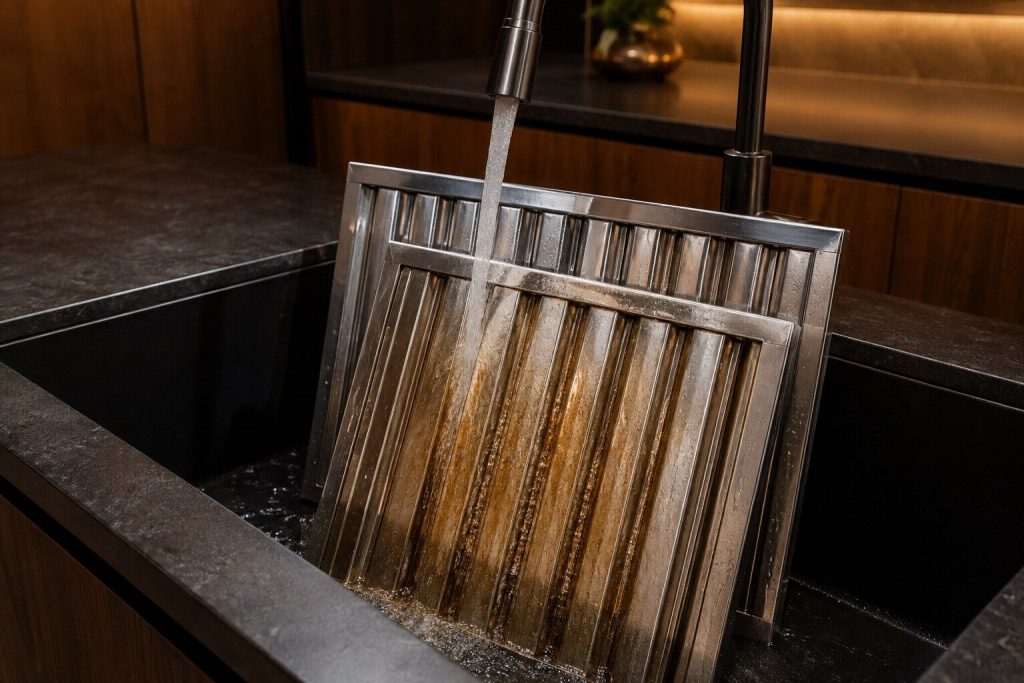
Hood Filters in a Miami Kitchen: Far More Often Than the Manual Says
Grease plus humidity stays tacky, collects dust, and migrates past a saturated filter into the blower housing. That is when it stops being a chore.
Read more -
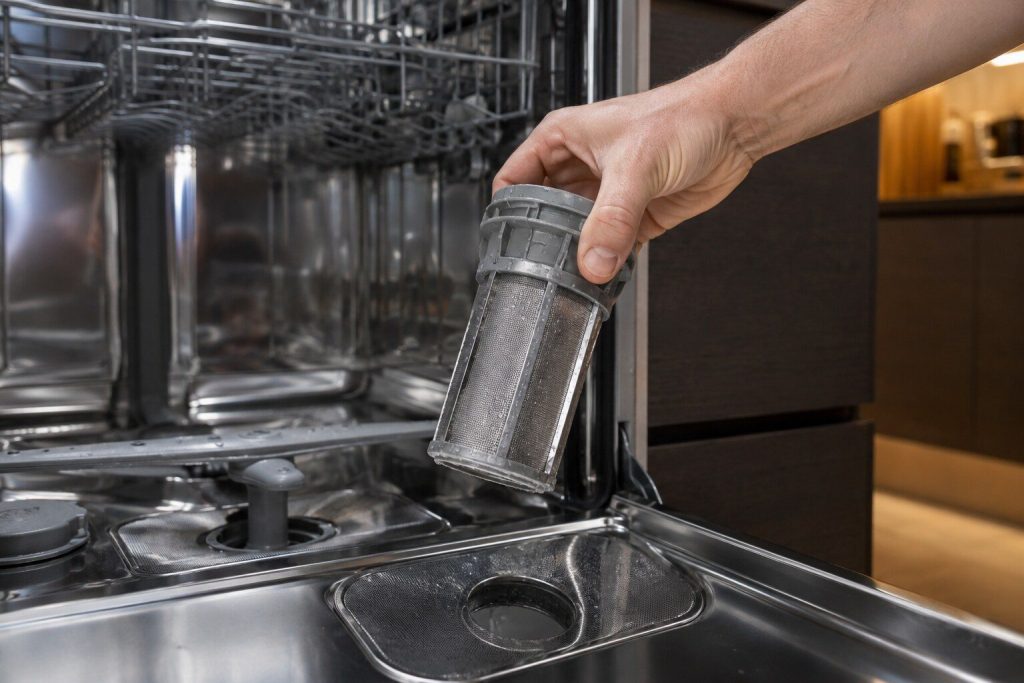
The Filter in the Floor of the Tub: Two Minutes, No Tools
The highest-value thing an owner can do for this appliance, and most have never done it. Quarter turn, lift, rinse.
Read more -
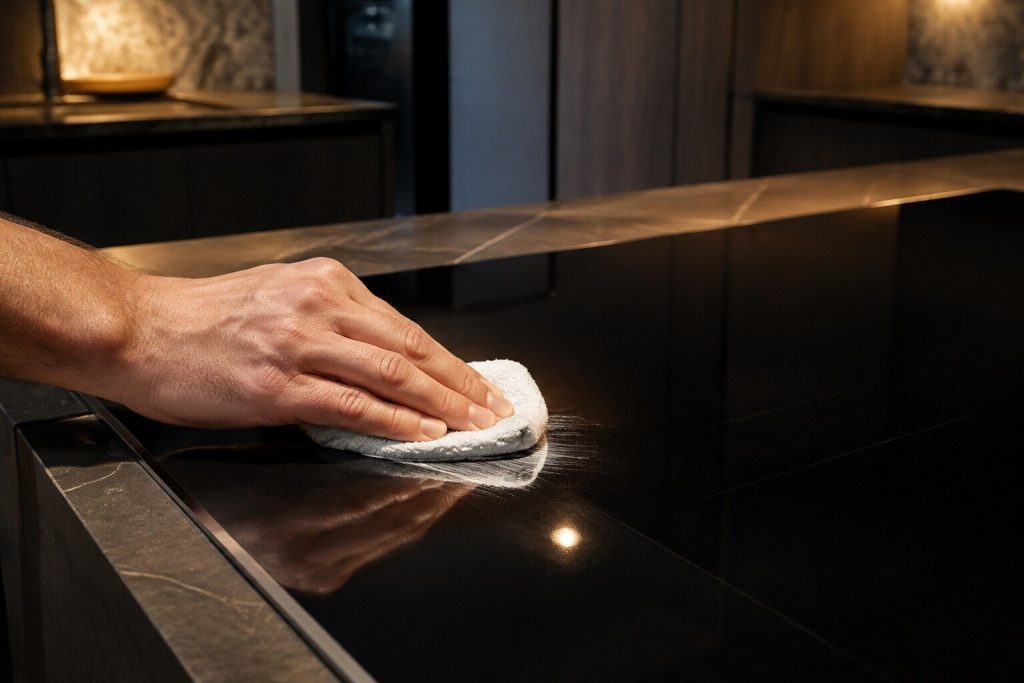
Cleaning Induction Glass Without Marking It
Sugar comes off hot and everything else comes off cold, which is the opposite of what most people assume. And two common products do permanent damage.
Read more
Tell us the model number and what it is doing.
This article is based on:
- Official manufacturer documentation
- Internal repair procedures
- Technician repair history
- Company quality standards