Safety & Risks
An Oven That Smells of Burning: Which Smells Are Normal and Which Are Not
Work out which smell you have, because they mean different things. A new oven or a newly replaced element smells of hot metal and sometimes faintly of plastic for the first few hours of use as manufacturing residues burn off, and that fades and does not come back. An oven after a self-clean cycle smells acrid for a day and that is the cycle doing its job. Food debris on the floor of the cavity or spilled onto an element smells of burning food and stops once it is cleaned out. What is not normal is a sharp smell of burning plastic or of hot electrical insulation that arrives on an appliance that has been in the house for years, that gets stronger rather than fading, or that comes with a flicker in the display, a tripping breaker or a visible mark near a connection. That one is a reason to switch the appliance off at the breaker and stop using it until somebody has looked.
The full guide
Four smells, and only one of them is a page about safety
Most burning smells from an oven are ordinary and temporary. A few are not, and the difference is worth knowing rather than guessing at, because the response to the ordinary ones is patience and the response to the other one is a breaker.
The three that are normal
A new appliance, or a newly replaced element. Manufacturing oils and residues on metal that has never been hot burn off in the first few hours of use. It smells of hot metal and often, unhelpfully, faintly of plastic. It fades with each use and it does not come back. Run the oven empty at a high temperature for an hour with the windows open and most of it is gone.
After a self-clean cycle. Self-clean takes the cavity far above any cooking temperature and turns whatever was in it to ash. The smell is real and it is acrid, and it is the cycle working rather than a warning. Ventilate the kitchen and expect it to clear within a day. If there is a bird in the house, it should be in another room with the door shut and a window open — pyrolytic cycles are a genuine hazard to birds and that is not folklore.
Food debris. A spill on the floor of the cavity, something that dripped onto an element, or a piece of paper from packaging that nobody noticed. It smells of burning food, it smokes when you preheat, and it stops for good once the cavity is cleaned out. The check is simple: look, with a torch, at the floor of the oven and along the element.
The one that is not
A sharp chemical smell of burning plastic or hot electrical insulation, on an appliance that has been in the house for years, that gets stronger rather than fading, and especially one that arrives with any of these:
- the display flickering, dimming or resetting itself
- a breaker that has tripped, even once
- a scorch mark or discoloration anywhere near a connection or a terminal
- the smell being strongest at the back of the appliance or at the control panel rather than in the cavity
Switch the appliance off at the breaker and stop using it. Not later — at that point in the reading.
Why we are firm about that
Ovens are hot, they are full of high-current connections, and they are built into cabinetry. Those three things are fine together for twenty years and they are not fine together with a connection that is failing.
The specific thing that goes wrong is resistance where there should be none: a terminal block that has degraded with years of heat, a connector that has corroded — and in this climate connectors corrode, because salt air gets into kitchens and gets into connectors. Resistance at a connection makes heat, heat makes more resistance, and the process accelerates. The smell is the insulation around it.
That is why "it only does it a bit" is not reassuring on this particular symptom. A little is how it starts.
What we look at
The terminal blocks where elements enter the cavity, which are a common finding on ovens that have run hot for years. Every connector in the control area. The supply and the grounding to the appliance. And the elements themselves, since an element failing at a terminal is one of the ways this begins.
It is usually not an expensive repair. What makes it worth a page in the safety section is that it is one of the very few symptoms on this site where the right answer is to stop using the appliance rather than to work through a list.
The one other smell worth naming
If you smell gas near a range, that is a different emergency and this page does not cover it. Leave the house, do not touch switches, and call the gas utility from outside before you call anybody else. That is the standard advice and there is no version of it that involves troubleshooting first.
The self-clean cycle deserves its own paragraph
More burning-smell calls trace to self-clean than to anything else, and most of them are not problems.
The cycle takes the cavity far above any cooking temperature and holds it there for hours, turning residue to ash. Everything in that cavity sees temperatures it otherwise never sees, and that includes the door seal, the wiring near the elements and the latch mechanism. The smell during and after is real, it is strong, and it clears within a day with the kitchen ventilated.
Three things are worth knowing about it.
Take everything out first. Racks, the probe, foil, a thermometer somebody left in. Racks in particular discolor permanently and can lose their easy slide.
Birds must be in another room. Pyrolytic cycles are a genuine hazard to pet birds and this is not folklore. Another room, door shut, window open.
Expect problems to surface afterwards. This is the part nobody says. If a latch, a sensor or a connection was marginal, the self-clean cycle is what finds it, and a code appearing the day after a cycle is extremely common. That is not the cycle breaking the oven; it is the cycle testing it harder than a year of cooking does.
Used occasionally, self-clean is fine. Used monthly, it is why we get called.
What "it smells hot" usually is on a built-in
There is a smell people describe as hot rather than burning, and on a built-in installation it usually has an ordinary explanation.
A wall oven vents into the cabinetry around it through defined paths, and those paths take away heat that would otherwise stay in the joinery. When something obstructs them — a remodel that boxed in a run, a drawer packed to the back, a trim piece fitted without the clearance the specification asks for — the cabinet gets hotter than it should and everything in it smells of warm wood and warm adhesive.
That is worth attention even though nothing has failed, because a cabinet running hot for years is a cabinet that will eventually mark, and because the appliance's own electronics are in that same space. On these ovens a blocked cooling path can produce F350, which the manufacturer's table gives as the upper cooling fan circuit or an obstruction in it.
Ventilation, which is part of the answer
A hood that is actually moving air removes cooking smells before they become a question, and a great many kitchens here have hoods that lost half their airflow years ago without anybody noticing.
If your kitchen smells of last night in the morning, that is not an oven problem and it is not going to be fixed by cleaning the oven. It is filters, a duct, a termination outside, or a tightly sealed house with nowhere for make-up air to come from.
What we would check, and in what order
Cavity first, with a torch, because food debris is common and free to eliminate. Then the terminal blocks where the elements enter, which are the usual finding on ovens that have run hot for years. Then every connector in the control area, since coastal air gets into them. Then the supply and the grounding to the appliance.
And we would ask two questions that decide a great deal: how old is the appliance, and did anything else happen at the same time. A new oven and an old one with the same smell are two different conversations, and a smell that arrived with a tripped breaker is not a smell — it is two symptoms of one thing.
If it turns out to be a repair
What this leads to, and what it costs
Every job on this site is priced the same way: an on-site diagnostic first, the figure agreed in writing before anybody starts.
-
Wall ovens
Monogram's wall ovens come in two design languages — Statement, with its heavy handles and brass, and Minimalist, which is flush and handle-less — plus French-door models, in-oven cameras, warming drawers, and the Advantium 5-in-1 that cooks with halogen light as well as microwave energy. They share a control platform and an F-code family, and they are all installed into cabinetry, which is where the repair difficulty lives.
- Single, double and French-door wall ovens in 27 and 30 inches
- Advantium 5-in-1 comes in 120 V and 240 V versions that fail differently
- F codes name the sensor, the keypad or the door latch
-
Professional ranges
Monogram does not make an ordinary range. The line is professional: 30, 36 and 48 inches, dual-fuel with a gas top over an electric oven, all-gas throughout, or induction — with griddles and grills on the wider models. A 48-inch dual-fuel range is a gas appliance, an electric appliance and a ventilation problem in one piece of steel, and the diagnosis starts by working out which of the three is talking.
- Dual-fuel, all-gas and induction, 30 to 48 inches
- Griddle and grill sections are their own repair
- The F-code family covers the oven side, not the burners
-
Appliance control board repair
The repair reached last and reached for first by the internet. A control board is expensive, frequently blamed and comparatively rarely the problem — most of what gets called a board failure is a sensor, a harness or a connector that has corroded in coastal air. Boards are condemned here by measurement.
- Everything the board depends on tested first
- Connectors and harnesses are the usual real cause
- Codes that name the control taken seriously, not literally
-
Monogram oven error code F2 or F20
Monogram oven error code F2 or F20: Shown as F2 or F20. Which machines can actually raise it, where the number lives on this make, and what to do next.
What this one means
Questions people ask about this
Our oven is new and the whole house smells.
That is the burn-off and it is expected. Run it empty at a high temperature for an hour with the kitchen ventilated and the windows open, and it will have largely gone by the end of it. If it is still doing it after several uses, that is different and worth asking about.
It only smells during self-clean.
That is the cycle working. Self-clean takes the cavity far above cooking temperature and turns residue to ash, and the smell that comes with it is real. Ventilate, keep birds out of the room entirely, and expect it to clear within a day.
How do I tell electrical from plastic?
Honestly, most people cannot with confidence, and that is fine — the rule does not depend on it. Any sharp chemical or plastic smell on an appliance that is not new and has not just been cleaned deserves the same response: switch it off at the breaker and have it looked at.
The breaker has tripped once as well.
Then stop using it now. A smell plus a trip is two symptoms of the same thing, and they are the two symptoms that matter. Leave it off at the breaker until somebody has been.
Safety & Risks
More guides like this one
-
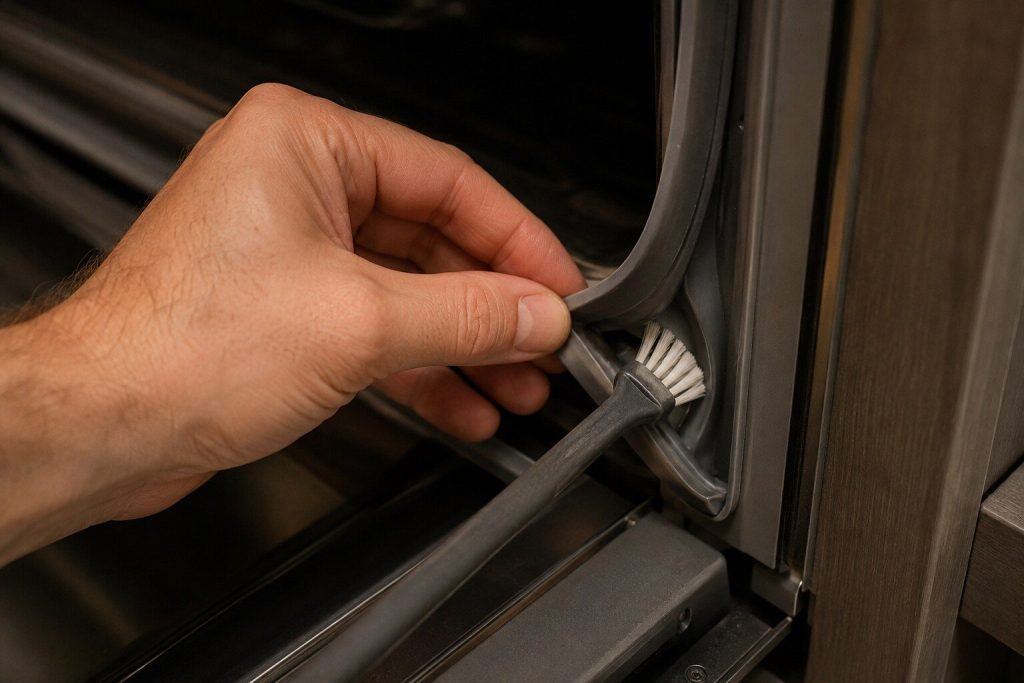
Mold in the Folds of a Door Seal: Getting It Out Without Wrecking the Gasket
The products people reach for are what hardens the rubber. Warm soapy water, a soft brush and the folds opened out does more, and does no damage.
Read more -
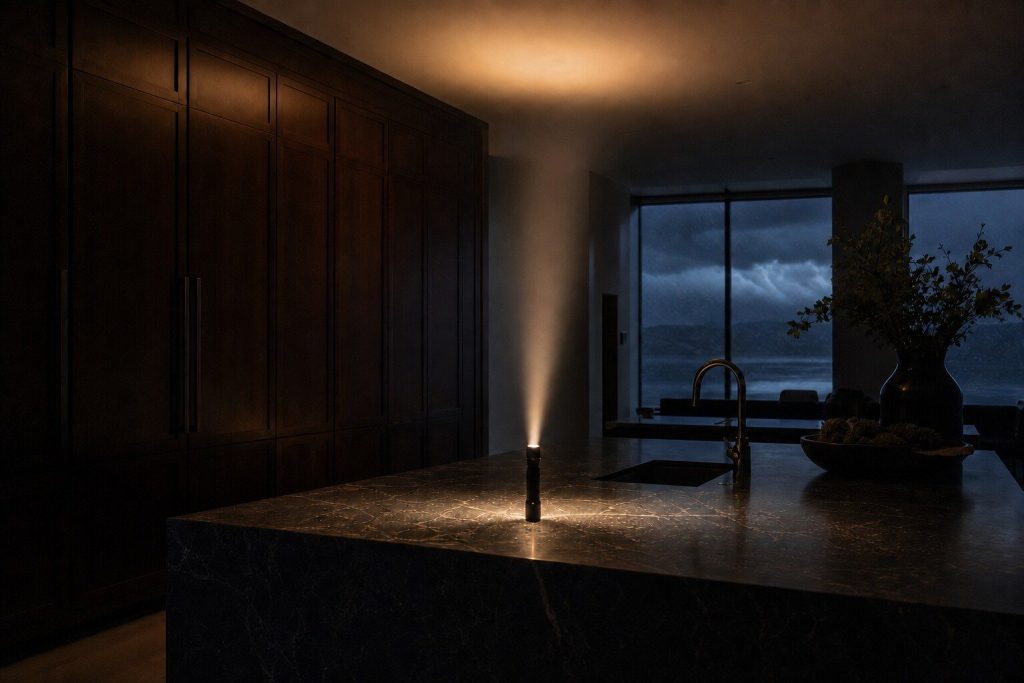
After an Outage: How Long the Food in a Built-In Actually Lasts
Four hours closed for a refrigerator, twenty-four to forty-eight for a freezer depending on how full it is — and the clock only runs if the door stays shut.
Read more
Tell us the model number and what it is doing.
This article is based on:
- Official manufacturer documentation
- Internal repair procedures
- Technician repair history
- Company quality standards