Cost Expectations
How Long This Equipment Lasts, and When Repair Stops Being Sensible
Built-in refrigeration commonly runs fifteen to twenty years and often longer with the condensers kept clean; dishwashers and ice machines sit lower, around ten to fifteen; cooking appliances vary most, because a professional gas range is largely mechanical and a control-heavy wall oven is not. Those figures matter less than the arithmetic around them. On a freestanding appliance the comparison is a repair against a delivery, and a large repair on an old machine loses. On built-in equipment the comparison is a repair against a cabinetry project: the opening was cut for that appliance, the panel was made for that door, and a replacement that does not match the opening brings a cabinetmaker with it. That moves the line years later, which is why a sealed system repair that would be uneconomic on a freestanding refrigerator is usually sound on an integrated column. Where replacement does win is on control-heavy appliances whose boards are no longer made, and on anything where a second failure is already visible.
The full guide
The comparison most people make is the wrong one
Somebody is quoted a large repair and reaches, quite reasonably, for a comparison: what would a new one cost? On a freestanding appliance that is the right question, and a repair approaching a third of a replacement generally loses.
On built-in equipment it is the wrong question, and getting it wrong costs a great deal more than getting it right.
The opening in the cabinetry was cut for this appliance. The door panel was made for this door, from material that may no longer be available, by a cabinetmaker who may no longer be trading. The appliance beside it was chosen to match. Replacing an integrated column is not a delivery — it is a project with a joiner in it, and the number at the end of that is not the number on the appliance's price tag.
That single fact moves the repair-or-replace line years later on this catalog than on anything else in this fleet, and it is why a sealed system repair that we would honestly advise against on a freestanding refrigerator is usually the right decision on one of these.
What actually lasts, roughly
Built-in and integrated refrigeration: fifteen to twenty years, and frequently longer. These are built to be serviced and they are serviced from the front. The thing that decides the number is almost always the compressor, and the thing that decides the compressor is whether the condenser was ever cleaned.
Dishwashers and ice machines: ten to fifteen. Both spend their lives in water, and on unsoftened South Florida supply the water is not gentle. Descaling and filters shift the number meaningfully.
Professional gas ranges: the longest on the list. A gas top is burners, valves and igniters — mechanical parts, individually replaceable, with no electronics doing the cooking. Ranges like these are routinely still working at twenty-five years, and the parts that fail are the parts that are meant to.
Control-heavy appliances: the shortest and the least predictable. A wall oven with a screen, a camera and a board doing everything is a longer-lived cavity attached to a shorter-lived computer.
The three things that end an appliance early here
A condenser nobody ever cleaned. It is the cheapest service on this site and the one that protects the most expensive component. In a coastal kitchen the coil takes salt as well as grease and dust, and the appliance never reports a word of it — it simply runs hotter and longer for a decade until the compressor gives up.
A door that stopped sealing. Humid air, permanently, into a cabinet whose defrost circuit was sized for a door that opens and shuts. Everything downstream works harder for years.
A house shut up through the summer. A second home closed for four months in the heat asks more of its refrigeration than an occupied one, not less.
None of those three is a manufacturing question. All three are maintenance, and all three are why two identical cabinets fitted in the same year can be eight years apart in condition.
When replacement genuinely wins
We would rather say this plainly than be seen to argue in one direction.
When the board is no longer made. On older built-in equipment this is a real question, and where the answer is that the part is gone, there is no repair to discuss.
When a second failure is already visible. A cabinet needing a compressor whose door seals have also hardened and whose evaporator fan is noisy is not one repair. Adding those up honestly sometimes ends at replacement.
When the appliance was wrong for where it is. An indoor-rated beverage center built into an outdoor bar will keep failing, and no repair changes the environment it is in.
When the kitchen is being redone anyway. If the joinery is coming out regardless, the cabinetry argument disappears and the arithmetic goes back to being ordinary.
What we will do about it
Put the numbers side by side on the visit, including the ones that are not on our invoice — the panel, the opening, the neighboring cabinet. Tell you what we found and what we did not find. And say which failures we think are wear and which look like a machine that is going, because those are different answers to the same question.
Every figure on this site is a starting point rather than a quote, and this page is the reason that matters: on this equipment the decision is rarely about the repair alone.
The questions worth asking at the diagnostic
If you are facing a large number on an older appliance, these four make the decision rather than the feeling.
What else did you find? One failing component on an otherwise sound machine is a repair. The same component on a machine whose seals have hardened, whose fan is noisy and whose condenser has never been cleaned is the first of several.
Is the part still made, and how long? Availability is a real constraint on built-in equipment past a certain age, and a part that is available now on a discontinued line may not be in three years.
What would replacement actually involve here? Not the appliance price. The opening, the panel, the neighboring cabinet, and whether a current model even fits the hole. That is the honest comparison and it is frequently the one nobody has done.
What does this appliance owe us? A twelve-year-old dishwasher and a twelve-year-old integrated column are at very different points in their lives.
The two failures that decide most of these
The compressor, on refrigeration. It is the largest repair and the one that ends cabinets. What decides it is heat: a compressor working against a condenser that cannot shed heat runs hotter and longer for years, and it wears accordingly. That is the entire argument for the cheapest service on this site.
The control board, on cooking appliances. It is not usually wear — boards fail on their own schedule, and nothing an owner does changes it much. What does change is whether the board is still made, and on a control-heavy oven that is the question that ends the conversation one way or the other.
Everything else — elements, igniters, valves, pumps, seals, fans, sensors — is a defined part with a defined price, and none of it decides the life of the appliance on its own.
Age is not the same as condition
Two identical columns fitted in the same year can be eight years apart in practice, and the difference is never the manufacturing.
It is whether the condenser was cleaned. Whether the door was adjusted when it dropped. Whether the house was occupied through the summers. Whether the kitchen is two blocks from the water or twelve miles inland. Whether anybody ever descaled the ice machine.
None of those are visible in a model year, and all of them are visible on the visit. It is why we will not answer "should I repair a fifteen-year-old refrigerator" over the phone — the number tells you very little, and an hour with the appliance tells you most of it.
What we would rather do
Say what we found, put both numbers side by side including the ones that are not on our invoice, and tell you honestly which failures look like wear and which look like a machine that is going.
We would rather lose a job than sell a repair on a cabinet with three things wrong with it. And we would rather talk somebody out of replacing a sound appliance than let a five-figure column be scrapped because the comparison was made against a delivery price that has nothing to do with what replacing it here would actually cost.
If it turns out to be a repair
What this leads to, and what it costs
Every job on this site is priced the same way: an on-site diagnostic first, the figure agreed in writing before anybody starts.
-
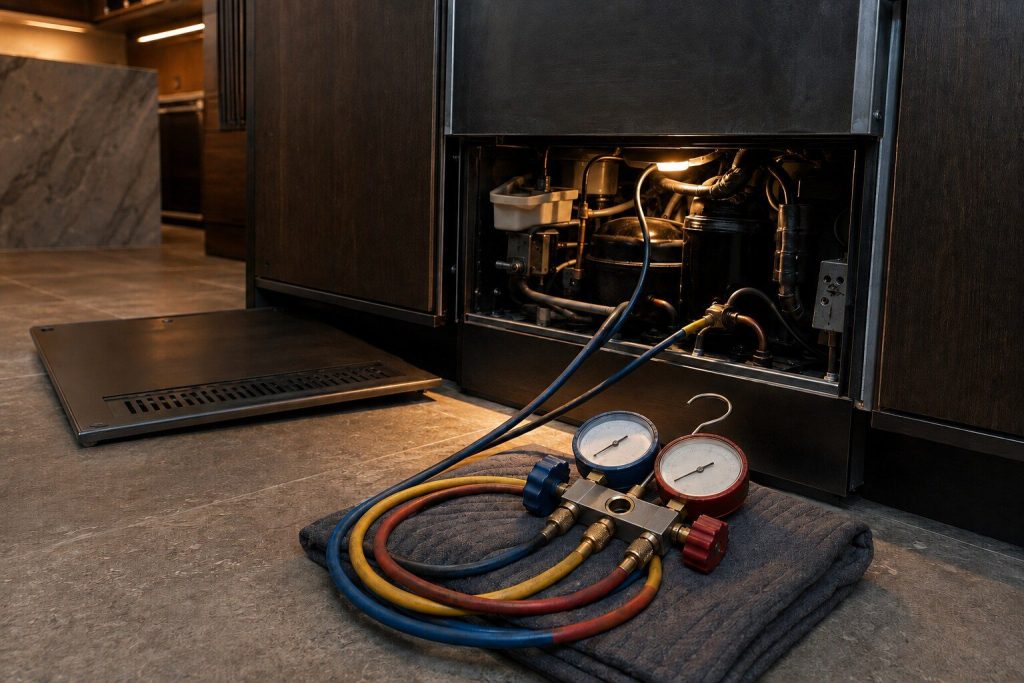
from $695 Sealed system repair cost
The largest repair on a cold appliance, and the one where the figure has to be honest before the work rather than after. On a five-figure integrated cabinet it is usually still the right decision — which is genuinely not true of every make.
- from $695, quoted in writing before starting
- Reached by measurement, never by elimination
- Honest about when a cabinet is not worth it
-
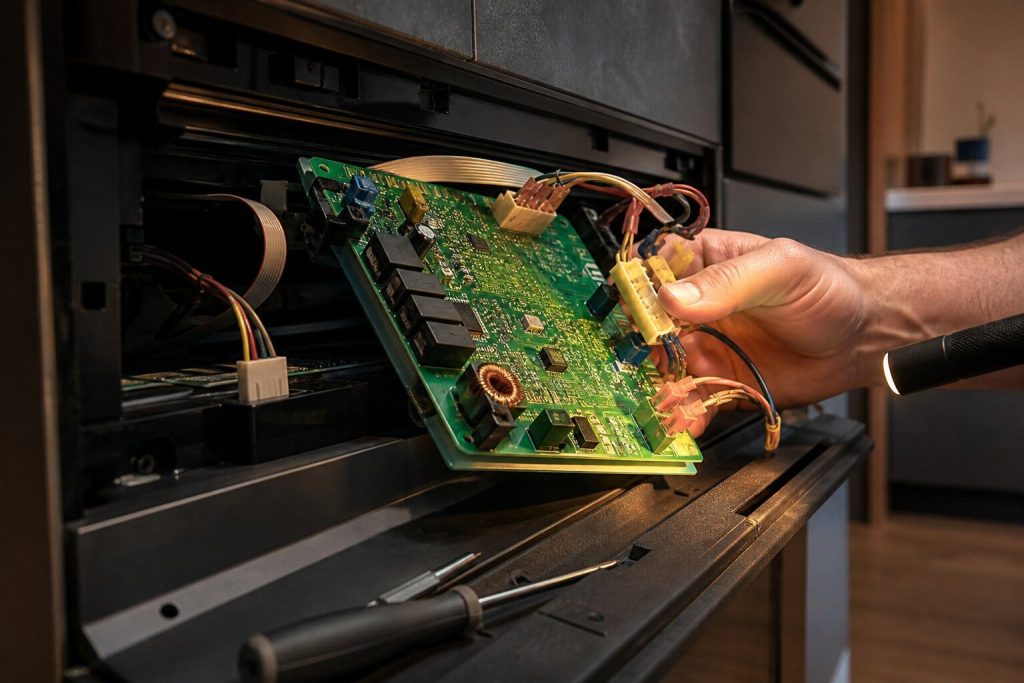
from $295 Control board repair cost
The largest of the electronic repairs and the most over-diagnosed one. Boards are condemned here by measurement, because most of what gets called a board failure is a sensor, a harness or a connector that has corroded in coastal air.
- from $295, and only after the inputs are tested
- Connectors are the usual real cause here
- Availability checked before anything is promised
-

from $145 Appliance maintenance
The visit that exists to stop the other visits. On built-in appliances in a salt-air climate the two things that shorten life are both invisible: a condenser that has silted up behind its grille, and door seals that have quietly stopped sealing. Neither shows on a display. Both are cheap to deal with and expensive to ignore.
- Condensers cleaned and airflow checked
- Seals, hinges and panel alignment across the kitchen
- Filters, drains and water circuits attended to
-

Built-in side-by-side · integrated column · French door · bottom freezer Refrigerators
Monogram refrigeration is built in, and on this make that is not a styling word — it is what the repair has to work around. A 48-inch side-by-side is bolted into cabinetry, a column is flush with the run and carries a custom door panel, and the machinery is reached from the front because there is no behind. The failures are ordinary refrigeration failures. Getting to them, and putting the kitchen back the way the cabinetmaker left it, is the part that takes the skill.
- Built-in and panel-ready models are serviced from the front
- Door panels and alignment are part of the job, not an extra
- Sealed-system work is measured, never guessed at

Questions people ask about this
Is a five-figure repair ever sensible?
On a built-in cabinet, sometimes yes, and the reason is not sentiment. Replacing an integrated column means matching an opening, matching a panel and matching a neighboring cabinet, and by the time that is done the number is not the one on the appliance's price tag. We will put both numbers side by side rather than assume either way.
Are parts still available for older Monogram appliances?
Often, and not always, and it is a fair question on anything past a certain age. Mechanical parts last longest in the supply chain; control boards are the first to go. We check availability before a repair is agreed rather than after, and we say plainly when something is genuinely gone.
Does maintenance actually extend the life?
For refrigeration, measurably. A condenser that can shed heat is a compressor that is not working against itself, and compressors are what decides the life of a cold appliance. For a control board, no — boards fail on their own schedule and nothing an owner does changes it.
What is the worst thing for the life of these appliances here?
Salt air on a condenser that nobody cleans, and a door that stopped sealing two years ago. Both are cheap to deal with, neither is ever reported by the appliance, and between them they account for most of the refrigeration we see that has aged before its time.
Cost Expectations
More guides like this one
-
What a Service Call Costs Here, and What the Diagnostic Fee Buys
Why nobody can give you a firm number on the phone, what actually moves a figure on built-in equipment, and where our numbers come from.
Read more
Tell us the model number and what it is doing.
This article is based on:
- Official manufacturer documentation
- Internal repair procedures
- Technician repair history
- Company quality standards